
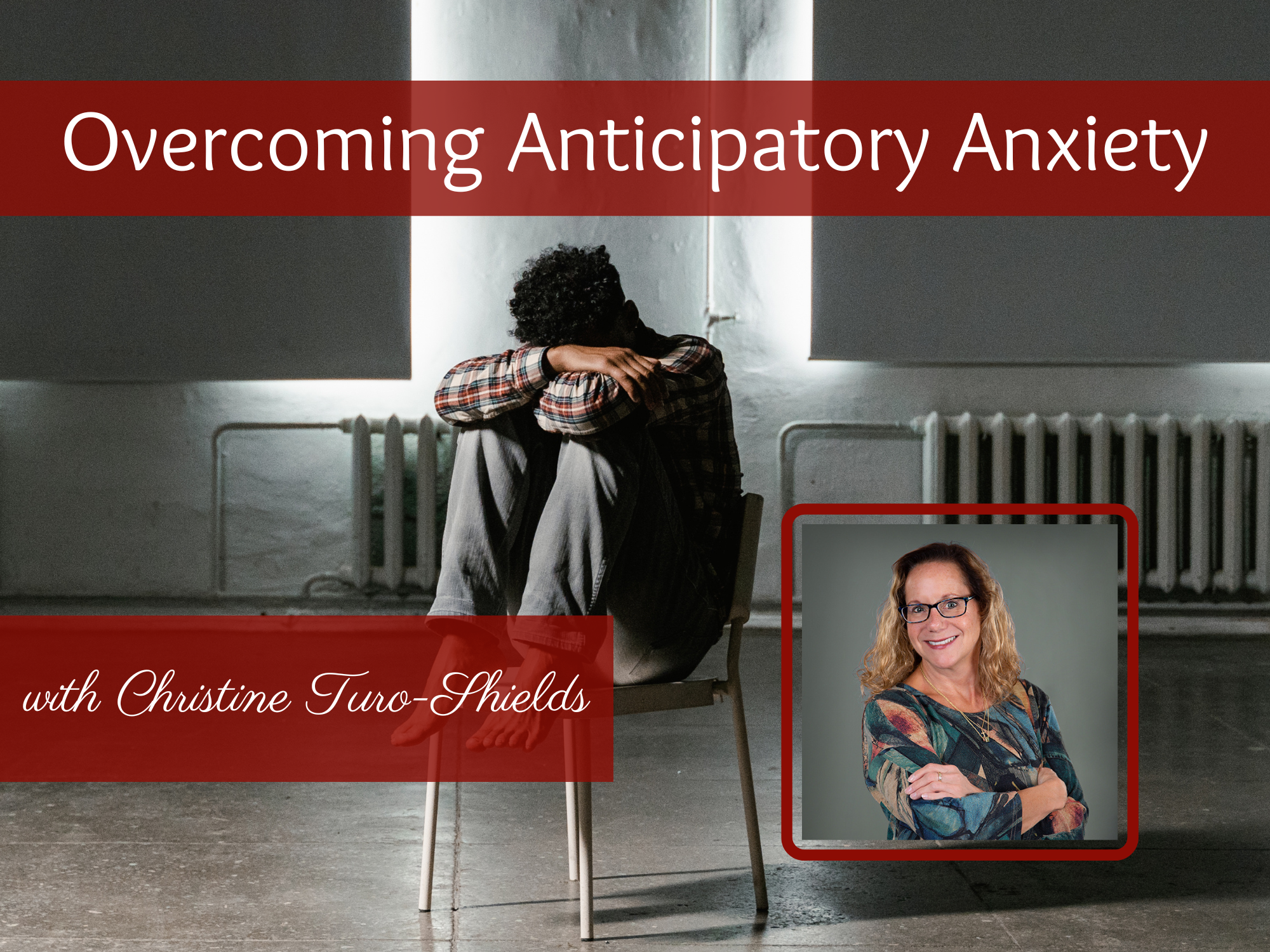
If you struggle with anxiety, then you’re probably familiar with the overwhelming feeling of dread that comes when worrying about a future event or situation. This type of worry, known as anticipatory anxiety, is a common yet often overlooked form of anxiety that causes significant distress in the lives of those who experience it.
Kenosis Counseling Center owner Christine Turo-Shields, LCSW, LCAC, has more than 30 years of experience helping individuals who suffer from anxiety and other mental health challenges. She is an expert at helping people of all ages work through their anxious thoughts and learn to live with anxiety. Christine often emphasizes the dangers of anticipatory anxiety when working with her clients, knowing both personally and professionally how much it can reduce one’s quality of life.
In this blog post, Christine shares her expertise regarding anticipatory anxiety, explaining what it is, why it can be so debilitating, and—most importantly—how it can be managed effectively. When you’ve finished reading, you’ll be ready to reclaim greater peace and control of your life with practical strategies for reducing anticipatory anxiety.

What Is Anticipatory Anxiety?
Anticipatory anxiety is the fear, worry, or dread experienced when thinking about future events, especially those with outcomes that are uncertain or expected to be negative. It can carry all the normal symptoms of anxiety, with the main difference being that these symptoms occur before the anticipated event happens.
Many people who have anticipatory anxiety attempt to avoid the situations they fear as a way of managing their anxiety. Unfortunately, this behavior only reinforces anxious thoughts, making them more likely to occur again.
Christine shares a personal example from her life to illustrate how anticipatory anxiety can take hold:
“My mom had anxiety about any type of social gathering. Whether it was a family gathering or a trip she was taking with my dad, she would always say, ‘I’m not going to go.’ When I was in fifth grade, they were going on a trip to Hawaii. Weeks and days before, she started saying she wasn’t going to go. My little kid mind couldn’t comprehend why someone wouldn’t want to go to Hawaii, but I get it now. The anticipation of what’s going to happen—the uncertainty, the unknown—can cause people to avoid the event altogether.”
As exemplified by Christine’s story, anticipatory anxiety is more than mere worry; it can significantly limit life experiences. It traps individuals in cycles of worry that prevent them from fully engaging with the world around them.
When an expected negative event cannot be avoided, anticipatory anxiety can make the hours and days leading up to it an experience of sheer agony. Consider another story that Christine shares from a former client:
“I was working with one woman who was distressed about some medical testing. It was a Thursday, and she said, ‘I know I have cancer.’ I said, ‘Oh my goodness, when did you get the results?’ She said, ‘Well, I haven’t gotten the results. I’m getting them Tuesday.’ I said, ‘So you believe you have cancer.’ She said, ‘No, I know I have cancer.’ Then I said, ‘Do you want cancer this weekend? Because you just told me you’re going to know on Tuesday, and the nice thing about medical tests is eventually we will get some definitive answer.’ And she said, ‘Well, no, I don’t want cancer this weekend.’ I said, ‘OK, here’s the deal: you get to decide whether you have cancer this weekend. I want you to call me on Tuesday and let me know what the results are. If on Tuesday you have cancer, then I’ll cry with you. That will be the time to worry.’ Then I got a voicemail on Tuesday: ‘Hey Christine, just wanted to let you know I don’t have cancer…and I didn’t have cancer this weekend!’ ”
Waiting for news that might be bad is always a challenging situation. But anticipatory anxiety can lead us to jump to the worst possible conclusion before it is a known fact, leading to unnecessary suffering if and when our fears are not realized.

The Cognitive Distortions Behind Anticipatory Anxiety
Anticipatory anxiety both results from and fuels irrational patterns of thinking, known in psychology as cognitive distortions. Specifically, individuals experiencing anticipatory anxiety may confuse possibility with probability, believing unlikely outcomes to be highly likely or even guaranteed.
“In an anxious brain, something that is possible is typically responded to as if it’s probable,” Christine says. “This one young lady I worked with told me, ‘I know I’m going to fail this test.’ I said, ‘What’s your grade point average?’ She said, ‘4.0.’ I said, ‘Have you failed a test yet?’ ‘No.’ ‘OK, so what’s the probability that you’re actually going to fail?’ ”
Anticipatory anxiety distorts a person’s perception by twisting small possibilities into nearly certain disasters. The process of correcting these cognitive distortions, called cognitive restructuring, involves identifying and gently challenging such inaccuracies in thinking.
Another common example among anxious children involves excessive worry about the health of loved ones. “I’ve had to work with several kids who worried about their parents dying,” Christine says. “I’ll ask, ‘OK, how old is your mom?’ They’ll say ‘42’, or whatever age. I ask, ‘Does she have any chronic health issues?’ ‘No.’ ‘Is she pretty healthy?’ ‘Yeah.’ ‘How old did your grandparents live to?’ Maybe they’re in their 70s or 80s. ‘So what’s the possibility versus the probability that she’s going to die of some health condition?’ ”
By guiding individuals to differentiate between what’s merely possible and what’s realistically probable, cognitive restructuring helps manage anticipatory anxiety. This approach uses logic to challenge distorted thinking, providing relief from the emotional distress that anticipatory anxiety causes.

Coping Strategies for Anticipatory Anxiety
Although anticipatory anxiety is a powerful and distressing experience, it can be managed and even overcome through practice. Here are several cognitive strategies you can begin using today to manage anticipatory anxiety.
Challenge Your Anxious Thoughts
Whenever you feel certain that something bad will happen, remember that believing something is true doesn’t actually make it so.
“Beliefs are not facts, and feelings aren’t facts either,” Christine says. “Unless you have a crystal ball or are God, we cannot tell the future.”
Christine advises her clients to change the words they use when thinking or speaking about future events. “I want people to use language that’s fair and accurate, so when somebody says, ‘I know’, I always challenge them to say, ‘I believe, I fear, I expect’.”
This subtle shift can remind you that possibility is not probability and reinforce rational thinking rather than emotional spiraling.
Don’t Experience Stress Twice
Feeling anticipatory anxiety about a future event doubles the amount of stress that event ultimately causes you. First you feel stress while you wait for the event to occur, and then you feel stress again when it actually occurs.
“You lose time as you’re waiting for the event to happen,” Christine points out. And ironically, the stress caused by an anticipated event is often far less than the stress caused by anxious rumination. “If you know the event is going to be stressful, just wait until you get there, because usually by the time somebody gets there, they think, ‘Oh, that wasn’t that bad,’ ” she says.
Think back to Christine’s client who was convinced she had cancer. Not only were her beliefs incorrect, but she created a great deal of unnecessary stress for herself by anxiously ruminating about the results of her medical tests.
Christine shares another story from her own life that demonstrates the importance of not experiencing stress twice:
“Back in 2000, I was at a work retreat on the westside of Indianapolis, where it was storming, but without any tornadic activity. As I headed home, I learned that a string of 17 tornadoes had ripped through the southside right where I lived, and where the babysitter for my one-year-old and three-year-old children lived. As I navigated rush hour traffic in the storm, I wanted to get to my little ones as fast as I could. The words in my head were graphic; I was worrying quite literally that I might find my children’s ‘body parts strewn across the yard’. That intrusive thought caused me to grip the steering wheel harder and drive faster, which resulted in me hitting the brakes and hydroplaning. I became aware that causing an accident would make the situation worse, and so I chose not to experience stress twice. I negotiated with myself that IF I pulled up to the house and saw my kids’ body parts strewn across the lawn, I would then give myself full permission to go into a catatonic state and never talk to anyone again. With that permission in place, I was able to slow down, relax the grip on the wheel, breathe deeply, and turn on some piano music in the car for the rest of my ride home. Arriving over 30 minutes later, I pulled up to the babysitter’s house and found NO strewn body parts—not my kids’, nor any others. My mental crisis was averted, and I learned a significant life lesson in practicing what I preached: the more you can resist jumping to conclusions about a feared future event, the less stress you will have in your life, which can lead to a virtuous cycle of anxiety reduction.”
Change Your “Mental Channel”
Speaking of driving, imagine that you turned on your car radio and found it set to a station playing music you hate, detest or abhor. What would you do?
Would you keep listening to the music? Not likely. Most people would quickly change the channel to a different station—and as it turns out, anxious thoughts work the same way.
“When an anxious thought becomes intrusive, sometimes we feel like we can’t change it, and we just keep listening to it like awful music,” Christine says. However, it’s possible to change our “mental channel” by directing our thoughts elsewhere and reducing our anxious rumination.
“I can’t tell you how many times somebody has told me, ‘I just have to worry…’ ” Christine says. “You actually don’t have to worry. It doesn’t matter if there has been a tragedy; you don’t ‘have to’ worry.”
Rather than remaining tuned into your fears and uncertainties, learn to refocus your attention whenever your anxious thoughts grow too loud, just as Christine did in her personal story above. As you get better at changing the channel, you’ll see that worrying truly is a choice that you don’t have to make.